
If your warehouse is filling up, pallet racking is usually the first thing people start looking at. The trouble is that “pallet racking” covers a lot of ground. There are at least eight common systems, each suited to a different way of working, and the wrong choice can leave you with wasted space, slow picking, or a layout you cannot adapt later.
This guide cuts through that. We will explain what pallet racking is, how it is built, the main types and where each one earns its place, what affects the cost, and the UK safety rules you need to know about. By the end you should have a clear idea of which direction suits your operation, without needing to call in a consultant first.
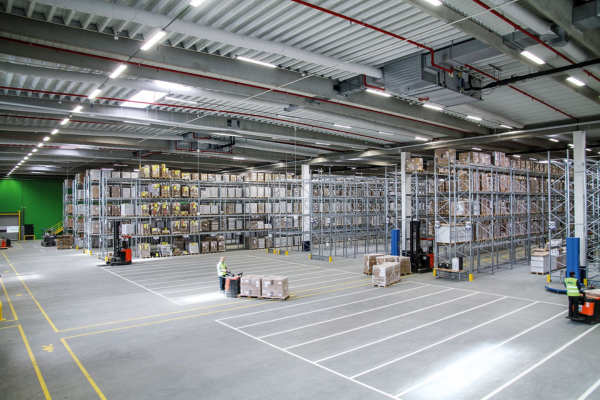
What is pallet racking?
Pallet racking is a heavy-duty storage system designed to hold goods on pallets, stacked vertically across multiple levels and accessed with a forklift or reach truck. Instead of stacking pallets on the floor, where they take up huge amounts of space and crush the loads underneath, you store them in a steel framework that uses the full height of the building.
The basic idea is simple. You take goods that arrive and leave in full pallet quantities, group them into unit loads, and store those loads off the floor in an organised, accessible structure. That gives you more capacity in the same footprint, direct access to your stock, and a much safer working environment than stacking pallets several high.
It is worth being clear about where racking sits compared with shelving, because the two often get confused. Pallet racking is built for heavy palletised goods moved by forklift. Warehouse shelving is built for lighter items picked by hand. Plenty of warehouses use both. If you are still deciding between them, our guide to warehouse shelving versus pallet racking breaks down the choice in detail.
How pallet racking works, and the parts it is made from
Every pallet racking system works on the same principle. Upright frames create the vertical structure, horizontal beams create the storage levels, and a forklift loads pallets into the bays. What changes between systems is how densely the pallets are packed and how you access them, which we will come to shortly.
Knowing the main components helps you understand quotes, load notices, and inspection reports later on. A standard system is built from:
- Uprights (upright frames): The tall steel posts that form the sides of each bay and carry the load down to the floor.
- Beams: The horizontal bars that connect the uprights and create each storage level. Beam capacity is one of the numbers you must never exceed.
- Base plates: The feet at the bottom of each upright, bolted to the floor to keep the frame stable.
- Bracing: The diagonal and horizontal struts inside each frame that stop it twisting and keep it rigid.
- Row spacers: Used where racking runs back to back, tying the two runs together for extra strength.
- Decking: Optional wire mesh or timber panels that let you store smaller items, loose goods, or non-standard pallets safely.
- Upright protectors and end barriers: Steel guards at floor level that take the knocks from forklift traffic and protect the structure.
- Load notices: The signage that displays the maximum bay and beam load. These are a legal requirement, not an extra.
Get the components right for your loads and the system does its job quietly for years. Cut corners on protection or ignore the load notices and you store up problems that cost far more to fix later.

The two families: selective and compact
Before you look at individual systems, it helps to know that nearly all pallet racking falls into one of two camps.
- Selective systems give you direct access to every pallet, every time. They are simple, flexible, and the cheapest to install, but they need more aisles, so you store fewer pallets in the same space.
- Compact (high-density) systems pack pallets together to fit far more into the building, usually by removing or reducing aisles. You gain capacity but lose some of that easy access to individual pallets.
The right choice comes down to a trade-off between access and density. If you hold a wide range of products and need to reach any of them at any moment, lean selective. If you store large volumes of the same product and floor space is at a premium, compact starts to make sense. Most of the systems below are simply different ways of striking that balance.
The main types of pallet racking
Adjustable (selective) pallet racking
Also called APR or wide aisle racking, this is the most common system in UK warehouses and the one most people picture when they think of racking. Pallets are stored one deep on each side of an aisle, and a standard counterbalance forklift loads and picks them.
- Best for: Mixed stock, frequent picking, and businesses that want flexibility.
- Strengths: Direct access to every pallet, low cost, easy to extend or reconfigure, works with standard forklifts.
- Trade-off: Lower storage density because of the aisle space it needs.
Narrow aisle and very narrow aisle (VNA) racking
This is selective racking with the aisles squeezed down to fit more rows into the same floor area. You keep direct access to every pallet, but you need specialist narrow aisle or articulated forklifts to work in the tighter space.
- Best for: Operations that need both high density and full selectivity, usually with tall buildings.
- Strengths: Big increase in capacity without losing access.
- Trade-off: Specialist trucks and tighter operating tolerances add cost and complexity.
Double deep racking
Pallets are stored two deep instead of one, which cuts the number of aisles and lifts your capacity. You need a reach truck with extended forks to get to the rear pallet.
- Best for: Holding several pallets of the same product without going fully high-density.
- Strengths: More storage than standard selective, while keeping a reasonable level of access.
- Trade-off: You lose direct access to the back pallet, so it suits slower-moving lines.
Drive-in and drive-through racking
High-density systems where the forklift drives right into the structure to load and retrieve pallets, which sit on supporting rails rather than individual beams. Drive-in has a single entry point and works last in, first out. Drive-through is open at both ends and works first in, first out.
- Best for: Large volumes of identical products where density matters more than selectivity.
- Strengths: Excellent use of space, very high capacity.
- Trade-off: Limited access to individual pallets and slower loading, so it suits a small number of SKUs.
Push back racking
Pallets sit on wheeled carts on inclined rails. As you load a new pallet, it pushes the one behind it further back. When you remove a pallet, the others roll forward. It gives you depth of storage from the aisle without the forklift ever entering the rack.
- Best for: High-density storage where you still want a handful of different products per lane.
- Strengths: Good density with quicker access than drive-in, all worked from the aisle.
- Trade-off: Runs last in, first out, so it is not ideal for strict date rotation.
Pallet live (gravity flow) racking
A compact system with gently sloped lanes of rollers. Pallets are loaded at the high end and roll under gravity to the picking face at the low end. Loading and picking happen on opposite sides, which gives you proper first in, first out rotation.
- Best for: Time-sensitive or perishable goods, and fast-moving operations.
- Strengths: Guaranteed stock rotation, high density, less forklift travel.
- Trade-off: Higher upfront cost and best suited to consistent pallet sizes.
Mobile pallet racking
Standard racking mounted on powered mobile bases that run on floor tracks. The runs sit closed together and open an aisle only where and when you need one. This removes nearly all the fixed aisle space.
- Best for: Very high density where floor space is scarce, including cold stores.
- Strengths: Huge capacity gain in the same footprint, full selectivity retained.
- Trade-off: Higher cost and slower access, since only one aisle opens at a time.
A note on cantilever racking
Cantilever racking is a close relative rather than a true pallet racking system. It uses arms extending from vertical columns to hold long, awkward loads like timber, pipe, and board that will not sit neatly on a pallet. If that sounds like your stock, our cantilever racking page covers it in more detail.

FIFO or LIFO? The bit that decides a lot of the above
Several of those systems come down to one question: in what order do you need to retrieve your stock?
- FIFO (first in, first out) means the oldest stock leaves first. It matters for food, drink, pharmaceuticals, and anything with a shelf life. Pallet live and drive-through racking are built for it.
- LIFO (last in, first out) means the most recently stored pallet leaves first. It is fine for non-perishable goods where rotation is not critical. Drive-in and push back racking work this way.
If you handle dated stock, decide your rotation method before you choose a system, because it rules some options straight out.
How much does pallet racking cost?
This is the question every guide avoids, so here is an honest answer: it depends, and any figure without a site survey is a rough guide at best. Pallet racking is usually priced per pallet position rather than as a single number, and the final cost moves with several factors:
- System type: Standard selective racking is the most affordable. High-density systems like pallet live, mobile, and push back cost considerably more per position because of the engineering involved.
- Height and load: Taller frames and heavier duty beams use more steel and cost more.
- Accessories: Mesh decking, pallet support bars, upright protectors, and end barriers all add to the total, though skipping the protective ones is a false economy.
- Supply only or installed: Installation, plus any required forklift or specialist trucks for narrow aisle and VNA systems, adds to the project cost.
- Site factors: Floor condition, building height, and access can all affect the design and the price.
As a rough starting point, standard selective racking sits at the lower end of the scale and is the most cost-effective way to add capacity, while compact and automated systems carry a premium that pays back through the space they save. The only way to get a figure you can actually budget against is a proper survey and quote based on your building and your stock. We are happy to provide that with no obligation.
Pallet racking safety and your legal duties in the UK
This is the part that gets overlooked, and it is the part that carries real legal weight. In the UK, racking is classed as work equipment under the Provision and Use of Work Equipment Regulations 1998 (PUWER), which means you have a legal duty to keep it safe and properly maintained. The Health and Safety Executive sets out detailed guidance in HSG76, and the Storage Equipment Manufacturers Association (SEMA) provides the industry standards most reputable suppliers work to.
A few things you are expected to have in place:
- A Person Responsible for Racking Safety (PRRS). You should appoint someone to take day-to-day responsibility for racking safety, inspections, and record keeping.
- Regular inspections. The HSE expects a visual inspection by trained staff at least weekly, plus a thorough annual inspection by a competent person such as a SEMA Approved Racking Inspector (SARI). This is the standard reflected in BS EN 15635.
- Load notices on every system. These must display the maximum bay and beam loads, and those limits must never be exceeded. Overloading is the single most common and most avoidable cause of rack failure.
- A clear way to handle damage. Inspectors use a traffic light system: green is within safe limits and recorded for monitoring, amber needs repair within four weeks and the affected location offloaded, and red means serious damage that must be offloaded and isolated immediately until it is fixed.
None of this is box-ticking. A collapsed run of racking is a serious safety incident, and HSE fines for poor management run into six and seven figures. It is also why the quality and certification of your racking matters: properly specified, correctly installed equipment gives you load ratings you can actually rely on. Safety and efficiency tend to pull in the same direction, a point we cover more fully in our guide to improving warehouse efficiency.

How to choose the right pallet racking system
If you are not sure which way to go, work through these questions before you speak to a supplier. Your answers will narrow the field quickly.
- What are you storing, and how heavy is it? Standard pallets of mixed weight point towards selective racking. Very heavy or dense loads need heavy duty systems.
- How many different products (SKUs) do you hold? A wide range needs the access of selective or VNA racking. A small number of high-volume lines suits drive-in, push back, or pallet live.
- How do you rotate stock? Dated or perishable goods need FIFO systems. Non-perishable stock can use LIFO.
- What forklifts do you run? Standard counterbalance trucks suit wide aisle racking. Narrow aisle and VNA need specialist trucks, which is a cost to factor in.
- What is your floor space and ceiling height? Limited floor with good height favours going taller and denser. Plenty of floor favours simpler selective layouts.
- What is your budget, and how fast are you growing? Selective racking is cheaper and easy to extend. High-density systems cost more but save space. If you expect to change, prioritise a system you can reconfigure.
There is rarely one perfect answer. The aim is a system that fits your stock and your building today, with room to adapt as the business changes.
Supply only or fully installed?
Once you know the system, there are two ways to get it in.
- Supply only: If you have a capable warehouse team, we can supply the racking with fast nationwide delivery and let you handle the fit-out.
- Fully installed: If you would rather hand the whole job over, our trained and insured fitters will assemble it on site, correctly configured and ready to load.
Either way, it pays to get a CAD layout produced before anything goes up, so you know the design works for your space, your flow, and your forklift access. Planning the layout properly is far cheaper than moving racking after it is installed.
Where Unirack fits in
Unirack is a specialist division of Advanced Commercial Interiors, and we supply and install storage systems for warehouses across the UK. We provide pallet racking on a supply-only or fully installed basis, with CAD design support so you can plan the space before committing. Our components meet recognised standards, so the load ratings you are given are ones you can trust in a real working warehouse.
If pallet racking is right for your operation, the best next step is a proper conversation about your building and your stock. We can design, supply, and install the system that fits.
Frequently asked questions
What is pallet racking?
Pallet racking is a heavy-duty steel storage system that holds palletised goods on multiple levels, accessed by forklift. It uses the full height of a building to store far more in the same floor space than stacking pallets on the ground.
What are the main types of pallet racking?
The most common types are adjustable (selective) racking, narrow aisle and very narrow aisle racking, double deep racking, drive-in and drive-through racking, push back racking, pallet live (gravity flow) racking, and mobile racking. Each balances access against storage density in a different way.
What is the most common type of pallet racking?
Adjustable pallet racking, also called selective or wide aisle racking, is by far the most common. It gives direct access to every pallet, works with standard forklifts, and is the most affordable and flexible system to install.
How much does pallet racking cost?
Pallet racking is usually priced per pallet position, and the cost depends on the system type, height, load capacity, accessories, and whether you need installation. Standard selective racking is the most cost-effective option. High-density systems cost more but save space. A site survey is the only way to get an accurate figure.
How often does pallet racking need to be inspected?
The HSE expects a visual inspection by trained staff at least weekly, plus a thorough annual inspection by a competent person such as a SEMA Approved Racking Inspector. You should also appoint a Person Responsible for Racking Safety to manage day-to-day checks and records.
What is the difference between pallet racking and shelving?
Pallet racking stores heavy palletised goods moved by forklift, while warehouse shelving stores lighter items picked by hand. Many warehouses use both, with racking for bulk storage and shelving for pick-face stock.
How high can pallet racking go?
Pallet racking can reach 10 metres or more, depending on your ceiling height, the forklifts you use, and the system specified. Narrow aisle and VNA systems are often used to make the most of tall buildings.
Ready to get a quote?
Whether you need a supply-only order or a fully installed system, we would be glad to help. Get a free quote online, call us on 0115 939 7572, or send us an existing quote and we will beat it.