
Small parts rarely run out of space. They run out of findability. A stores team can hold thousands of SKUs in a surprisingly small footprint, but if a picker has to hunt for a fixing, or two near-identical parts end up sharing a bin, every saving on floor space is lost to wasted time and mispicks.
Good small parts storage shelving solves that by giving every part one obvious home that fits it. This guide is for warehouse and stores managers planning a new parts store or fixing an existing one. It covers how to profile your parts, choose shelving, size bins, use dividers and louvre panels, set shelf heights and label everything so it stays findable.
Start With Your Parts, Not Your Shelving
The most common mistake is choosing shelving first and squeezing parts into it afterwards. Start with a list of every SKU you will hold, with three pieces of information for each: its rough size, the maximum quantity you will hold in its pick location, and how often it is picked.
Pick frequency matters more than most people expect. In parts stores, a small share of SKUs usually accounts for most of the activity. Research on automotive service parts warehouses notes that around 20% of products typically account for about 80% of turnover. Sorting your parts into fast, medium and slow movers (often called ABC analysis) tells you which parts deserve the best locations and which can live higher up, lower down or further away.
That one exercise shapes every decision that follows, from how many bays you need to which bin sizes to order.
Choosing Small Parts Storage Shelving
For a parts store, the shelving needs to do three things well: carry light to medium loads safely, adjust easily as your stock changes, and expand without starting again.
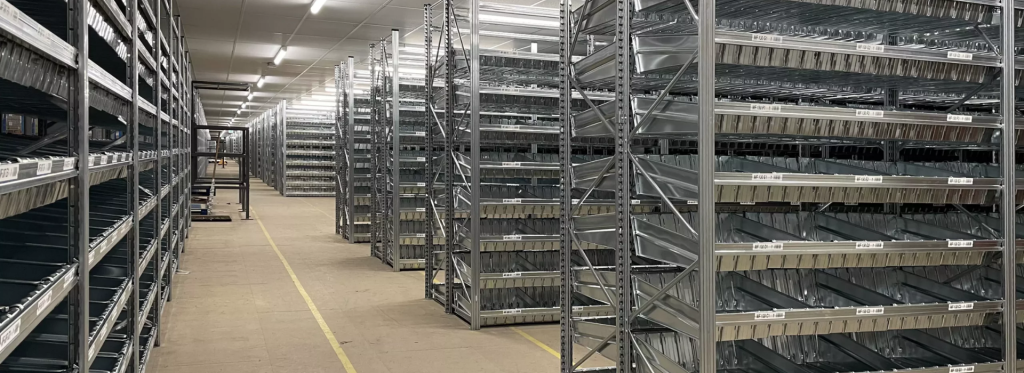
Boltless modular shelving is the natural fit. Unirack, developed by Italian manufacturer Metalsistem, is designed to be modular, with components that clip together so you can add bays or move shelves without tools or bolts. The wider Metalsistem system supports dividers, modular containers, label holders and shelf trays. That means bins and shelving can be planned together as one parts storage system, instead of as separate purchases that never quite line up.
Shelf depth is worth thinking about early. A deeper shelf holds more bins, but parts at the back are harder to see and reach, so shallow-to-medium depths usually suit fast-moving small parts better. Our warehouse shelving page covers the available configurations.
Whatever you choose, know your safe working loads. SEMA, the storage equipment trade body, points out that the best source for safe working load data is the shelving supplier, and that without a load notice, employers need another way to tell staff how to use the equipment safely. Small parts feel light individually, but a shelf full of steel fixings can be heavier than it looks.
Bins: Sizing Them to the Part
Bins are where most parts stores go wrong, usually by being too big. An oversized bin wastes shelf space and buries small quantities at the bottom, where they are easy to miss. An undersized bin overflows and gets topped up into whatever is next to it.
The simplest rule is to size each bin to the maximum quantity you hold in that location, plus a little headroom for a delivery arriving before the bin is empty. Keep the number of bin sizes small, ideally three or four, so bins fit your shelf depths neatly and spares can be swapped around as stock changes.
Open-fronted pick bins work well for fast movers, because pickers can see and grab parts without pulling the bin out. Slower lines can sit in closed or deeper bins further from the pick face. Whatever bins you choose, measure them before you set your shelf spacing, because their height decides how many levels each bay can hold.
Louvre Panel Bins: Where They Fit
Louvre panels are slotted steel panels that bins hang from, usually fixed to a wall, a bench back or the end of a shelving run. Louvre panel bins are excellent at the point of use. They keep consumables, fixings and common spares visible and within arm’s reach of a workbench or assembly line, without taking up bench space.
They are not a replacement for shelving in the main store. A wall of louvre panels holds far fewer parts than the same footprint of bin shelving, and it gets hard to manage beyond a few dozen lines. The best setups use both: shelving for the main stock, with louvre panels near the work holding a small working quantity, topped up from the store.
Dividers: When a Shelf Beats a Bin
Not every part needs a bin. Boxed items, flat parts, gaskets, bagged kits and anything that arrives in its own packaging often store better directly on the shelf, separated by shelf dividers. Dividers give each line a defined lane, stop stock creeping into the next location, and let you adjust the lane width as stock levels change.
A practical rule is that loose, rolling or very small parts go in bins, while parts that already have their own packaging go between dividers. Very small, high-value or easily lost items, such as precision components, may be better in drawer units or lockable storage within the same run.
Shelf Spacing and Heights
Shelf spacing decides both capacity and comfort. Set each shelf pitch to the height of the bins it holds, plus enough clearance to get a hand in and lift a bin out. Too little clearance and staff will pull bins out at an angle and spill them. Too much and you lose a level in every bay.
Height matters for safety as much as speed. The HSE’s guidance on lifting tasks says to aim for loads to be lifted between knee height and elbow height, and to examine shelf heights to reduce reaching above shoulder and head height. It also suggests mobile steps for light, infrequently handled loads at high level.
In practice, that means putting your fast movers and heavier bins in the middle levels of each bay. Slow-moving and lighter lines go on the top and bottom shelves. The middle band between knee and shoulder height is often called the golden zone, and it is your most valuable space. Because Unirack shelves can be repositioned easily, you can fine-tune spacing after go-live as you learn which parts move fastest.
Labelling and Location Codes
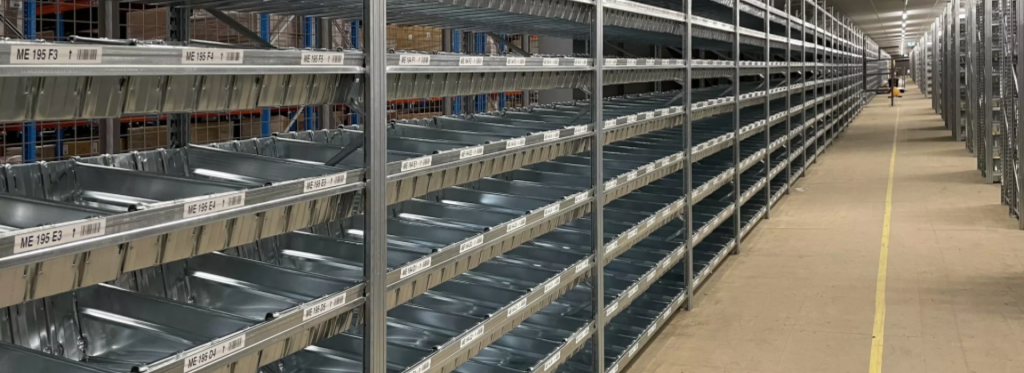
Labelling is what turns shelving into a system. Give every location a unique code that reads like an address, for example zone, aisle, bay, level and position. Label both the shelf edge and the bin, so a bin returned to the wrong place is obvious at a glance.
Hold each SKU in one pick location wherever possible. When a part lives in two or three places, stock counts drift and pickers stop trusting the system. If you use barcodes, put them on the location label as well as the bin, so scanning the location confirms the pick. Keep a few empty locations in each zone for new lines, so new parts get a proper home instead of being squeezed in wherever there is a gap.

Keeping the Store Findable
A parts store set up well on day one can still drift. Pick patterns change, new lines arrive and old ones go slow. Review your fast movers periodically, because ABC classifications need regular updating from recent order history to stay accurate, especially in seasonal operations. Move parts that have climbed into the fast-moving band into the golden zone, and push slow movers out to the edges.
Don’t forget the shelving itself. Shelving is work equipment, and SEMA notes that while there are no specific rules separating longspan shelving from pallet racking, whether it needs formal inspection depends on your site risk assessment. A collapse of even low-rise shelving can cause serious injury. A simple routine of visual checks for damage, overloading and missing components is a sensible minimum.
Saving Floor Space as the Store Grows
When a parts store outgrows its footprint, there are two main ways to gain capacity without moving. Mobile shelving mounts bays on rails so you only open an aisle where you need it, which suits slower-moving parts and archive stock. One of our recent projects, a mobile Unirack system for Trent Instruments, used exactly this approach.
The other option is to go upwards. Unirack can be built in multiple tiers with integral walkways, and for larger stores, our sister company The Mezzanine Company designs storage mezzanine floors that put a full extra level of shelving above the existing floor. If part of your stock is palletised or long, pallet racking and cantilever racking from the same manufacturer work alongside Unirack shelving in one storage scheme.
Get Your Parts Store Planned
Unirack supplies commercial shelving for parts stores across the UK, either supply only or fully installed by our own teams. We are based in Nottingham, source directly through the manufacturer’s UK importer, and will beat a like-for-like Unirack quote.
To get an accurate quote quickly, it helps to have three things ready: rough dimensions of the space, an idea of how many SKUs you hold, and the sizes of any bins you already use. Get in touch with our team and we will help you plan a parts store that stays findable.
Frequently Asked Questions
What is the best shelving for small parts storage?
Boltless, adjustable steel shelving designed for light to medium loads suits most parts stores. It lets you change shelf heights as your stock changes and add bays as you grow.
How do I choose the right bin size for small parts?
Size each bin to the maximum quantity you hold in that location, with a little headroom for deliveries. Stick to three or four standard sizes so bins fit your shelving and can be swapped around.
Are Louvre panel bins better than shelving?
They do different jobs. Louvre panels are best at the point of use, near benches and assembly lines, while shelving holds the main stock far more densely.