
Stand in a busy warehouse and long span shelving and pallet racking can look like close cousins. Both are bays of galvanised steel, both climb toward the roof, and both promise to hold a lot of stock in an orderly way. But they are built for different jobs, and choosing between them on looks alone is how businesses end up paying for a system that fights their stock rather than storing it. Get it right and everything from picking speed to safety to how much you can fit in the building improves. Get it wrong and you are either forklifting things that should be hand picked, or hand balancing loads that belong on a pallet.
The good news is that the decision is not complicated once you stop comparing the steel and start looking at your stock. The question of long span shelving vs pallet racking almost always comes down to what you store, how heavy it is, and how you move it in and out. This guide walks through those factors so you can match the system to your goods with confidence. If your question is the broader one of shelving versus racking in general, our guide to warehouse shelving vs pallet racking covers that wider comparison. This article focuses specifically on long span, the heavy end of shelving that most closely rivals racking, and where the line between the two actually falls.
The short answer
If your stock arrives and moves on pallets, handled by a forklift, pallet racking is almost certainly what you need. If your stock is bulky or awkward but loaded by hand, on a trolley or with an order picker rather than lifted by the pallet, long span shelving is very likely the better fit. That single distinction, palletised and forklift handled versus loose and hand loaded, resolves the majority of cases before you get anywhere near the finer detail. Everything below is really about the situations where the answer is less obvious, and about being sure.
What long span shelving is built for
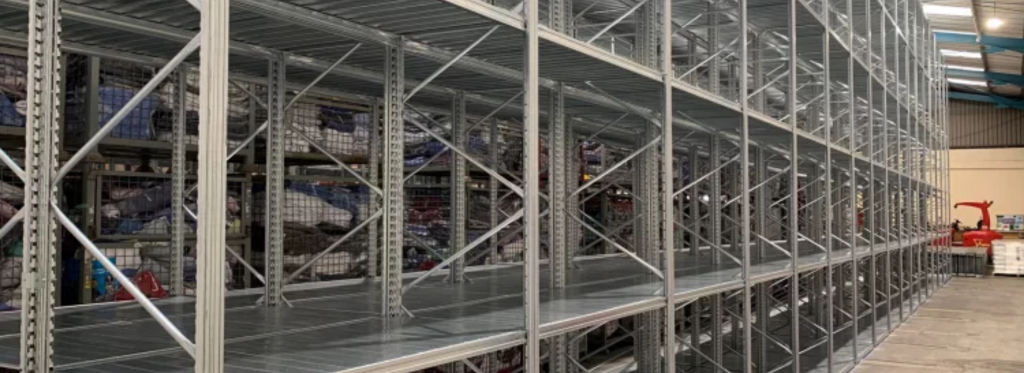
Long span shelving sits in a very specific and useful niche. It is the practical middle ground between light duty shelving, which handles boxes and small parts, and full pallet racking, which handles palletised bulk. It is designed for items that are too big or heavy for standard shelving but that you still load and pick by hand rather than by forklift.
The defining feature is in the name. Long, wide beams create clear spans up to three metres across with few uprights getting in the way, so you get long, open shelves that swallow bulky goods neatly. Unirack long span carries up to 800kg per shelf level and up to 4,800kg per frame, with boltless, fully galvanised construction, beams in 70mm box section, and levels that adjust in 33mm increments so you can tune the shelf heights to your stock. Frames go up to six metres, and depths run from 400mm to 1,200mm. That combination makes it ideal for large boxes, cartons, crates, totes, archive files, kits and spares, the kind of stock that is genuinely heavy in bulk but does not come on a pallet. You can see the full specification on our long span shelving page. The key thing to hold on to is that long span is hand loaded storage for bulky goods, with no forklift required.
What pallet racking is built for

Pallet racking solves a different problem entirely. It is engineered around the pallet as a unit load, and around the forklift or reach truck that puts pallets away and retrieves them. Where long span is measured in kilos per shelf, racking is measured in tonnes per bay, holding full palletised loads that no one could or should move by hand.
Because it is designed for mechanical handling, pallet racking can go considerably higher than shelving, often well beyond ten metres in the right building, and it stores palletised goods at a density that hand loaded systems cannot match. The trade off is that it depends on a forklift, needs aisles wide enough for that truck to operate safely, and is less nimble to reconfigure once installed. For businesses moving stock in and out by the pallet, in volume, none of that is a drawback, it is simply how high throughput storage works. Our pallet racking page sets out the systems, and if you want to understand racking in depth before deciding, our complete guide to pallet racking goes further into the detail.
The one question that usually decides it
If you take one thing from this article, make it this. The handling method is the single most reliable guide to which system you need. Ask how a typical item actually gets onto the shelf and back off it.
If the answer involves a forklift lifting a loaded pallet, you are in racking territory, because that is what racking is for and what long span shelving is not built to take. If the answer is a person lifting, a trolley, or an order picker moving individual items and cartons, long span is almost always the right home for it. This matters because the two systems are engineered around those different loads. Loading a long span bay with palletised weight it was never rated for is unsafe, and buying pallet racking for goods you only ever pick by hand means paying for forklift grade structure, and the forklift and aisles to serve it, that your operation does not actually need. Match the system to how the stock moves and most of the risk disappears.
Weight and how it is carried

Weight is closely tied to handling, but it is worth looking at on its own because it is where people most often push a system past its limits. Long span is genuinely strong, with that 800kg per shelf level covering a great deal of heavy but non palletised stock. What it is not designed to do is carry a one tonne loaded pallet dropped in by a forklift, where the weight arrives all at once and concentrated.
Pallet racking is built precisely for those concentrated unit loads, with uprights and beams rated to hold multiple heavy pallets per bay safely. So the weight question is not simply how heavy, it is how the weight is packaged and delivered. Heavy stock that comes as many hand sized pieces suits long span. Heavy stock that comes as full pallets suits racking. When your loads sit near the top of what long span can take and they are only going to grow, that is often the signal to move up to racking rather than push the shelving to its limit.
Size, shape, and when items are simply too long
Long span earns its place with bulky and awkward goods, the oversized cartons and irregular items that will not sit tidily on a standard shelf. Its wide, open bays are made for exactly that. But there is a limit at the other extreme, and it is worth knowing where the boundary lies.
When items are not just bulky but genuinely long, think timber, pipe, tube, board, extrusions or steel lengths that overhang any shelf, neither long span shelving nor conventional pallet racking is the right answer. That is the job of cantilever racking, which uses projecting arms with no front uprights to get in the way, so long loads can be stored and slid off from the side. If your stock is defined by its length rather than its weight or bulk, our cantilever racking is built for it, and it is a common reason a business that assumed it needed one of the two main systems actually needs a third. For everything short of that, standard warehouse shelving may be enough if the items are small and light, which is worth ruling out before you specify long span.
Access, picking and speed

How often you go to the stock, and how you pick it, should shape the decision too. Long span is built for accessibility. Every item sits on an open shelf at a height a person can reach or an order picker can serve, which makes it excellent for piece picking and for stock you dip into frequently. If your team is pulling individual cartons and items throughout the day, long span keeps them fast and forklift free.
Pallet racking is optimised for a different rhythm, the storage and retrieval of whole pallets, usually less frequently and in larger quantities. It is superb at holding bulk and feeding it out by the pallet, but it is not designed for someone to stand and hand pick dozens of small items from a high level, and it brings forklift traffic into the aisles, which has to be managed for safety. So if your operation is high frequency piece picking, lean toward long span. If it is lower frequency movement of palletised bulk, lean toward racking. Matching the system to your picking pattern is often what separates a warehouse that flows from one that queues.
Cost, space and flexibility
Budget and building both play a part once the stock question is settled. Long span is generally the more economical choice for non palletised goods, partly because the structure itself is less heavy duty than racking, and partly because it needs no forklift, no wide forklift aisles and no associated traffic management. Its boltless, adjustable design also makes it easy to reconfigure as your stock changes, which suits growing and evolving operations. You are not locking yourself into a fixed layout.
Pallet racking asks for a larger initial investment and a building set up for forklift operation, but in return it delivers unmatched density for palletised stock and the ability to use height that hand loading simply cannot reach. Neither is cheaper in any absolute sense, they are cheaper for different jobs. The most cost effective system is the one that matches your stock, because the real waste is buying capability you never use, or outgrowing a system within a year. If you want a structured way to work through the choice for hand loaded goods, our guide to choosing warehouse shelving takes you through it step by step.
When you need both
Plenty of warehouses do not choose one system at all, they run both, because most operations hold a mix of stock. Palletised bulk goes on racking, bulky hand picked lines go on long span, and the two work side by side, each doing what it does best. This is completely normal and often the smartest layout, and the aim is simply to put each type of stock where it belongs rather than force everything into a single system. If you are planning a mixed setup, our warehouse shelving vs pallet racking guide looks more closely at combining systems across a whole operation.
Frequently asked questions
What is the main difference between long span shelving and pallet racking?
Long span shelving is hand loaded storage for bulky, non palletised goods, carrying up to 800kg per shelf level with no forklift needed. Pallet racking is forklift loaded storage for palletised unit loads measured in tonnes per bay. The handling method, by hand or by forklift, is the clearest dividing line.
Can long span shelving hold pallets?
It is not designed to take full pallets loaded by a forklift, because that concentrated weight and mechanical handling is what pallet racking is engineered for. Long span is for goods you load and pick by hand, even when those goods are heavy in total.
Is long span shelving cheaper than pallet racking?
For non palletised goods it usually works out more economical, both because the structure is less heavy duty and because it needs no forklift, no wide forklift aisles and no traffic management. For palletised bulk, racking is the more cost effective choice despite the higher outlay, because it does a job long span cannot.
What if my stock is too long for either system?
Very long items such as timber, pipe, tube and board are best stored on cantilever racking, which uses projecting arms and no front uprights so long loads can be loaded and unloaded from the side. It is the right answer when length, rather than weight or bulk, is the defining feature of your stock.
Getting the right system for your stock
Long span shelving and pallet racking are not competitors so much as specialists, each built for a different kind of stock. Decide by looking at your goods rather than the steel: if it is palletised and forklift handled, racking is your system, and if it is bulky but hand loaded, long span is almost certainly the better fit, with cantilever waiting in the wings for anything genuinely long. Weigh up how your stock moves, how heavy and how large each item is, and how often you pick it, and the answer usually becomes obvious.
If you would like a hand matching the system to your stock, the Unirack team can help. We design, supply and install long span shelving, pallet racking and cantilever systems across the UK, and we are happy to look at what you store and recommend the right fit rather than the biggest sale. Call us on 0115 939 7572 to talk it through, and get a system that suits your stock from day one. Or, you can simply fill in the form below and a member of our technical team will come straight back to you!