
You are comparing two shelving systems. One quotes 300kg per shelf. The other says 250 daN. A third gives you a single “bay capacity” and nothing per shelf at all. On paper the first one looks strongest, but you are not comparing like with like, and the number that looks biggest is often the one telling you the least.
Shelving load capacity is one of the few specs where the headline figure can be technically true and practically useless at the same time. A shelf genuinely rated to 300kg can still fail under 300kg of your stock, depending on how that weight sits. So before you choose anything, it is worth understanding what these numbers actually describe, because once you can read them properly, the shelving that first looked strongest sometimes turns out to be the one hoping you would not ask.
What daN actually means, and how it converts to KGs
Start with the unit that throws people, because it is the one most suppliers quietly avoid. daN stands for decanewton, and it is a unit of force rather than mass. Engineers use it because steel does not resist kilograms, it resists force, and force is what a loaded shelf is actually dealing with.
The conversion is simpler than it looks. One daN is almost exactly one kilogram of load. To be precise, 1 daN equals about 1.02kg, so 100 daN is roughly 102kg and a shelf rated at 250 daN is holding a shade over 255kg. For any practical purpose in a stores or warehouse, you can read daN as “just over kg” and move on. It is not a bigger or smaller number dressed up, it is the same load expressed in the unit an engineer would actually use to calculate it.
Which raises the obvious question: if daN and kg are effectively the same, why does it matter which one a supplier prints? It matters because specifying in daN is usually a sign the figure came from load engineering rather than marketing, and that tends to travel with the other detail that actually decides whether a shelf holds.
The shelf weight limit is not the whole story
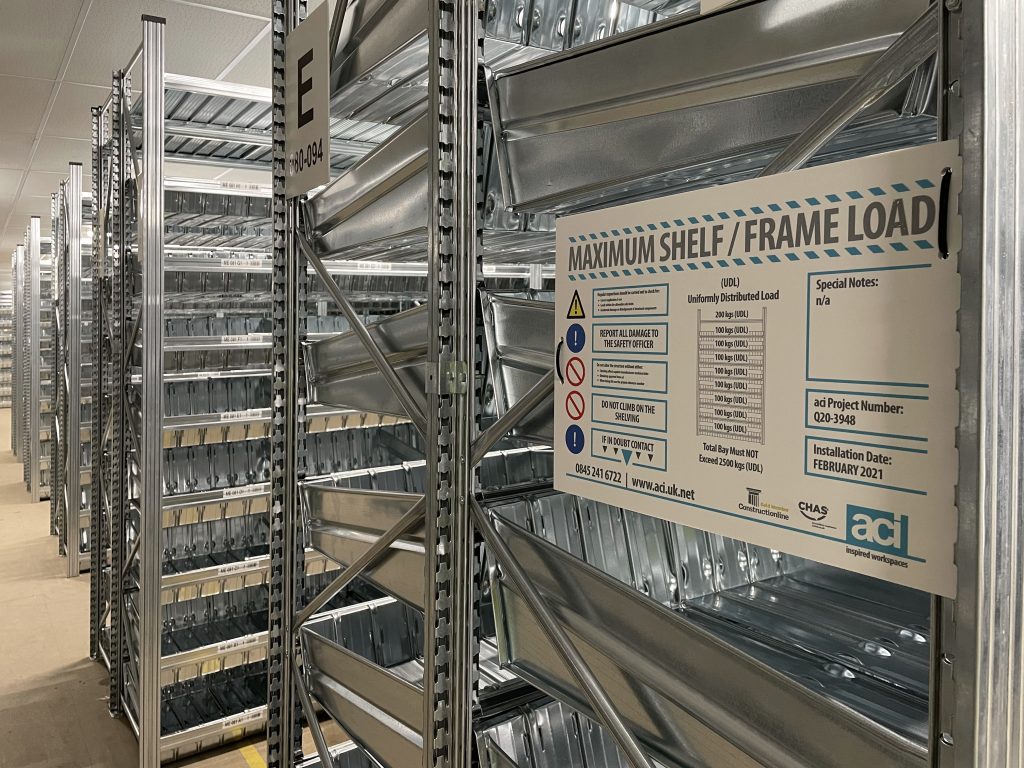
The first piece of missing detail is that there are two capacities on any shelving bay, not one, and they are easy to confuse. There is the shelf weight limit, which is what a single shelf level will carry, and there is the total bay capacity, which is what the uprights and frame will carry across every level combined.
These are different numbers and both bind you. A bay might have shelves each rated to 200kg, but if the frame is rated to 800kg total, you cannot load six of those shelves to 200kg and expect the uprights to hold 1,200kg. The per-shelf figure tells you how to load one level. The bay figure caps the whole thing. Any spec that gives you one without the other is only answering half the question, and it is worth checking both before you compare systems. Unirack lists both across its shelving range for exactly this reason.
UDL: The assumption hidden inside every rating
Here is the part that catches out even experienced stores managers, and it is the reason a 300kg shelf may not hold 300kg of your stock. Almost every shelf capacity you will ever see is a UDL figure. UDL means uniformly distributed load, and it describes weight spread evenly across the entire surface of the shelf.
That is the test condition behind the number. A shelf rated to 300kg UDL will hold 300kg only if that weight is laid out evenly from front to back and side to side. Concentrate the same weight and the safe figure drops, sometimes sharply. Put a heavy point load in the centre of the span and you are loading the shelf in the way it is weakest, because that is where a beam deflects most. Stack two dense items in one corner and the rest empty, and you are nowhere near the even spread the rating assumes.
So the honest way to read “300kg per shelf” is “300kg, provided it is spread like the test.” If your stock is dense and lumpy, a few heavy castings, a couple of full drums, motors, the real safe load can be well under the headline, and a shelf rated the same on paper as another can behave very differently once your actual boxes go on it. This is why UDL shelving figures need reading alongside how you genuinely load, not in isolation.

What else eats into the number on the sticker
UDL is the big one, but a few other things quietly reduce what a shelf will really take. Beam deflection over a long span means a wider bay of the same rating will sag more than a narrow one under the same load, so span and capacity have to be read together, which is where properly engineered long span shelving earns its place. Damage does the rest: a knocked or out-of-plumb upright, a bay that was never floor-fixed, corrosion on older steel, all pull the safe working load below the rating on day one. And loading is rarely gentle. Dropping a pallet’s worth of stock onto a level applies far more than its static weight for a moment, and shelving is rated for static load unless it says otherwise.
How to actually compare two specs
Once you know all this, comparing systems gets easier, because you know what to demand. For any capacity figure, ask four questions. Is it kg or daN, and therefore roughly the same either way. Is it per shelf or per bay, because you need both. Is it UDL or a point load, because that changes everything about how you can stack it. And at what configuration, since capacity falls as beam levels get longer or higher. A large kg number quoted with none of that context is a marketing figure. A daN figure quoted with span, level and UDL stated is an engineering one, and it is the second kind you want holding up your stock.
If your loads are genuinely heavy and concentrated, past the point where any shelving is the right tool, that is the signal to look at pallet racking instead, which is engineered for exactly that duty. Knowing where shelving stops and racking starts is part of reading capacity properly rather than forcing a system past what it was built for.
Read the spec this way and you stop being sold to by the biggest number on the page. You choose the shelving that is actually rated for how you load, which is the only rating that matters once the stock goes on.
Not sure what rating you actually need?
Reading the spec is one thing. Matching it to what you store is where it counts. Tell us what is going on the shelves, the weights, how dense it is, how it is loaded, and we will spec a system rated for your stock as it really sits, not as a test rig assumes. Every figure we quote is engineered, in daN, with the span and load type stated, so you know exactly what you are getting. Talk to Unirack about your loads and we will get you the right capacity first time.